

Beyond the Buzzword: What Business Model Innovation Really Means
In a competitive market, 'innovation' is more than just a new product or a flashy feature. True, sustainable disruption comes from something deeper: business model innovation. This is the strategic act of fundamentally rethinking how your company creates, delivers, and captures value. It involves challenging core industry assumptions and re-engineering the entire engine that drives your business, not just tuning a single part.
For bootstrapped tech startups and small businesses, this concept is a vital survival and growth mechanism. By innovating your business model, you can build a competitive moat that isn't reliant on massive funding. This powerful approach allows you to outmaneuver larger, more established players by changing the rules of the game itself, creating an advantage they cannot easily replicate.
This article moves beyond theory to provide a strategic deep dive into 8 transformative business model innovation examples. We will dissect the mechanics behind the success of giants like Netflix, Tesla, and Spotify, extracting the specific tactics, replicable strategies, and actionable takeaways you can apply to your own venture. Prepare to learn not just what they did, but how they did it, and how you can start building a more resilient and profitable business today.
1. Netflix: From DVD Rental to Streaming Platform
Netflix stands as one of the most powerful business model innovation examples of the digital age. The company executed a daring, multi-stage pivot, deliberately disrupting its own successful DVD-by-mail service to lead the streaming revolution. This wasn't merely a product update; it was a fundamental reinvention of its value proposition, revenue model, and operational infrastructure, shifting from physical logistics to global digital content delivery.
Strategic Analysis: Cannibalize and Conquer
The core of Netflix's innovation was its willingness to cannibalize its profitable DVD rental business. While competitors like Blockbuster remained tied to physical stores, Netflix foresaw that the future was digital. In 2007, it launched its streaming service, initially as a value-add for DVD subscribers. This gradual transition allowed the company to build a user base and gather data while its legacy model was still generating cash.
The next strategic leap was from content curator to content creator. With the launch of House of Cards in 2013, Netflix transformed from a distributor of other studios' content into a production powerhouse. This created a powerful "content moat," making a Netflix subscription indispensable for accessing exclusive, award-winning shows and movies, thereby reducing its dependence on fickle licensing deals.
The following infographic highlights the immense scale Netflix has achieved through this model.
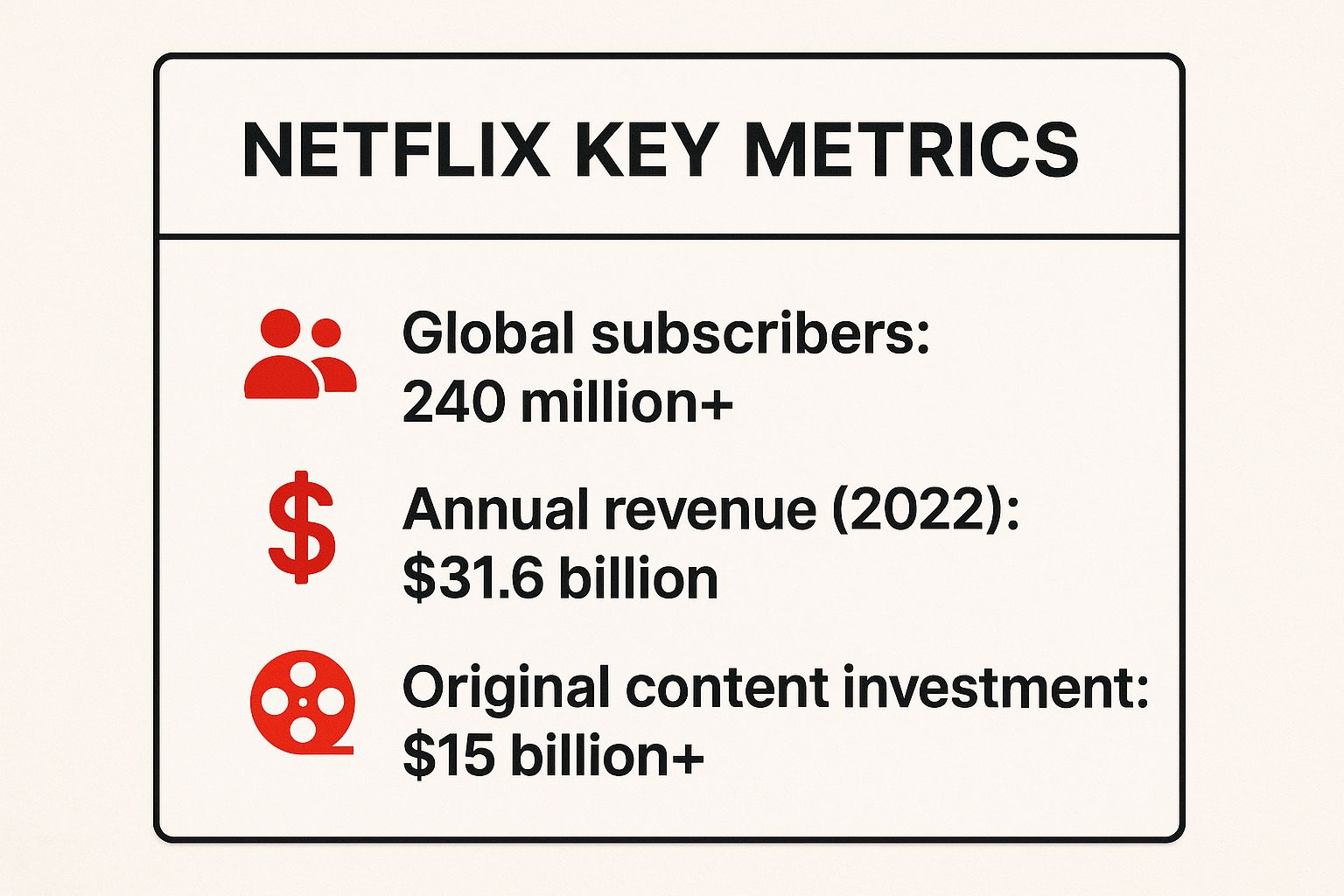
This data demonstrates a clear cycle: massive investment in original content directly fuels subscriber growth, which in turn generates the revenue to fund further content development.
Actionable Takeaways for Your Business
- Anticipate and Embrace Disruption: Proactively look for technological or behavioral shifts that could make your current business model obsolete. Begin investing in the "next thing" even while your current model is profitable.
- Build a Competitive Moat: Don't just compete on price. Create something unique that customers can't get elsewhere. This could be exclusive content, proprietary technology, a unique dataset, or a superior customer experience.
- Use Data to Drive Core Strategy: Netflix famously uses viewing data to personalize recommendations and green-light new projects. Use your own customer data to inform high-stakes decisions, not just minor optimizations.
2. Uber: Platform-Based Transportation Network
Uber fundamentally reshaped the personal transportation industry, becoming one of the most disruptive business model innovation examples of the last two decades. Instead of owning a fleet of vehicles like a traditional taxi company, Uber built a technology platform. This platform acts as a digital marketplace, seamlessly connecting independent drivers with riders in real time through a simple mobile application.

Strategic Analysis: The Asset-Light Network Effect
The genius of Uber's model lies in its asset-light approach. By not owning cars or directly employing drivers as full-time staff, Uber avoided massive capital expenditures and the complexities of fleet management. This allowed for explosive, low-cost scaling into new cities globally. The model's success hinges on creating a powerful two-sided network effect: more riders attract more drivers seeking income, and a larger pool of drivers provides faster pickups, which in turn attracts more riders.
Uber masterfully leveraged this network to expand its offerings beyond ride-hailing. The launch of Uber Eats utilized the existing platform infrastructure, user base, and driver network to enter the lucrative food delivery market. This diversification not only created a new revenue stream but also increased the platform's overall value and user engagement, making it a central part of a user's daily life.
Actionable Takeaways for Your Business
- Build a Two-Sided Marketplace: Don't just focus on acquiring customers; you must also build and incentivize the "supply" side of your platform. Uber subsidized early drivers and riders to kickstart the network effect.
- Embrace an Asset-Light Model: Ask if you can facilitate connections rather than owning the core assets. This reduces capital risk and enables rapid, flexible growth into new markets or service categories.
- Leverage Your Network for Diversification: Once you have an engaged user base, identify adjacent services you can offer. By expanding your platform's utility, you can increase customer lifetime value and improve your website conversion optimization by cross-promoting these new services.
3. Amazon: From E-commerce to Everything Store
Amazon’s transformation from a humble online bookstore into a global “everything store” is one of the most compelling business model innovation examples in history. The company's genius lies not in a single product but in the creation of a vast, interconnected ecosystem. It masterfully built complementary services around its core e-commerce engine, each strengthening the others to create unparalleled customer loyalty and an unassailable market position.
Strategic Analysis: The Flywheel and Platformization
Amazon’s strategy is famously driven by the "flywheel" concept. It starts with lower prices, which attract more customers. Increased customer traffic entices more third-party sellers to the platform, which vastly expands the selection of goods. This improved selection enhances the customer experience, which drives more traffic, creating a self-reinforcing cycle of growth. This model allows Amazon to lower its cost structure and further reduce prices, spinning the flywheel even faster.
The company's most disruptive innovation was arguably the creation of Amazon Web Services (AWS). By productizing its massive internal computing infrastructure, Amazon turned a cost center into its most profitable division. This platform-first thinking extends to its logistics network (Fulfillment by Amazon) and its expansion into physical retail with the acquisition of Whole Foods and the launch of cashierless Amazon Go stores, creating a true omnichannel empire.
Actionable Takeaways for Your Business
- Build a Virtuous Cycle: Instead of viewing business functions in isolation, map how improvements in one area (e.g., better customer service) can positively impact another (e.g., organic customer acquisition), creating a self-perpetuating growth loop.
- Monetize Your Internal Assets: Assess your company's unique internal tools, data, or operational capabilities. Is there a proprietary software or process that other businesses would find valuable? Selling it as a service can open entirely new revenue streams.
- Create an Irresistible Membership: Programs like Amazon Prime increase customer lifetime value by bundling high-value perks. Consider what services you can combine to make your offering indispensable, building a strong community and a brand that fosters deep loyalty.
4. Airbnb: Peer-to-Peer Accommodation Sharing
Airbnb introduced a disruptive model that turned the traditional hospitality industry on its head by creating a peer-to-peer marketplace for lodging. This is one of the most cited business model innovation examples because it didn't invent a new product but rather a new way to connect supply and demand. By building an asset-light platform, Airbnb unlocked the immense value of underutilized private homes, enabling individuals to become micro-entrepreneurs and travelers to find unique, localized accommodations.

Strategic Analysis: Building a Two-Sided Trust Engine
The core of Airbnb's strategy was not just creating a listing site but engineering a robust system of trust between strangers. While traditional hotels sell rooms, Airbnb sells the confidence to stay in someone's home. It achieved this through a multi-layered trust infrastructure: verified user profiles, secure payment processing, a two-way public review system, and comprehensive host protection programs like AirCover. This foundation was critical for overcoming initial user hesitation.
With trust established, Airbnb expanded its model horizontally to capture more of the travel experience. The launch of Airbnb Experiences allowed hosts to monetize local skills and tours, transforming the platform from a simple accommodation provider into a holistic travel companion. Further segmentation with Airbnb Plus (verified quality listings) and Airbnb for Work catered to different customer needs, deepening the company's market penetration and creating powerful network effects that make it difficult for new entrants to compete.
Actionable Takeaways for Your Business
- Engineer Trust into Your Platform: If your business model involves connecting two parties who don't know each other, your primary product is trust. Invest heavily in verification systems, transparent reviews, secure transactions, and clear protection policies to lower the barrier to entry for both sides of your marketplace.
- Empower the 'Supply' Side: The success of a two-sided market depends on a healthy and motivated supply side (your hosts, creators, or sellers). Provide them with powerful tools, analytics, educational resources, and support to help them succeed. When they thrive, your platform thrives.
- Unlock Value in Underutilized Assets: Analyze your market for dormant or underused assets, whether it's physical space, equipment, data, or specialized skills. Building a model to activate this latent supply can create an entirely new market category where you set the rules.
5. Tesla: Direct-to-Consumer Electric Vehicle Sales
Tesla shattered the century-old automotive dealership model by selling its revolutionary electric vehicles directly to consumers. This approach is one of the most audacious business model innovation examples in modern industry. Instead of relying on a network of third-party franchisees, Tesla built an end-to-end ecosystem it controls completely, from the initial online configuration to final delivery and ongoing service. This wasn't just about selling cars online; it was a fundamental re-architecting of the customer relationship in a legacy industry.

Strategic Analysis: Vertical Integration and Customer Control
The cornerstone of Tesla's strategy is vertical integration. By owning its showrooms, service centers, and the Supercharger network, the company ensures a consistent, premium brand experience at every touchpoint. This model eliminates the price haggling and high-pressure sales tactics common at traditional dealerships, replacing them with salaried, non-commissioned product specialists in sleek, mall-based galleries.
This direct-to-consumer (DTC) channel provides an invaluable, unfiltered feedback loop. Tesla gathers data directly from its customers, which informs everything from software updates pushed over-the-air to future vehicle design. This control extends to its Mobile Service, where technicians can perform repairs at a customer's home, turning a traditional pain point into a remarkably convenient experience. The model transforms the car from a static product into an evolving software platform.
Actionable Takeaways for Your Business
- Own the Customer Experience: Even if you can't vertically integrate everything, identify the most critical customer touchpoints. Invest in creating a seamless and branded experience online and offline to build loyalty and differentiate from competitors.
- Turn Service into a Strength: Re-examine your post-sale support. Can you transform a cost center like service or returns into a convenient, brand-enhancing experience that customers value? Tesla's mobile service is a prime example.
- Build a Direct Feedback Loop: Create direct channels for customer communication that bypass intermediaries. Use this firsthand data to rapidly iterate on your product, services, and overall business strategy, ensuring you stay aligned with market needs.
6. Spotify: Freemium Music Streaming Platform
Spotify's rise demonstrates how a carefully architected freemium model can redefine an entire industry. In an era dominated by illegal music downloads, Spotify presented a compelling legal alternative that was more convenient than piracy. This approach is one of the most studied business model innovation examples because it successfully monetized a product that consumers were accustomed to getting for free. The company created a symbiotic system where a free, ad-supported service directly fueled its premium subscription engine.
Strategic Analysis: Building a Two-Sided Market
The genius of Spotify's model was using its free tier as a massive, low-cost customer acquisition funnel. By offering instant access to a vast music library at no cost, it rapidly built an enormous user base, solving the chicken-and-egg problem that plagues many platforms. This scale served two critical purposes: it created an attractive audience for advertisers and, more importantly, it gave Spotify immense leverage when negotiating licensing deals with powerful record labels who were initially skeptical of streaming.
Once a user is in the ecosystem, the model focuses on converting them to a paid subscription. The free experience is strategically limited with ads, lower audio quality, and restrictions on mobile playback to consistently highlight the benefits of upgrading. Furthermore, Spotify's move into exclusive podcasts and original content mirrors Netflix's strategy, creating unique value and a defensive moat that competitors find difficult to replicate, reducing its reliance on music royalties alone.
Actionable Takeaways for Your Business
- Leverage Freemium as a Funnel: If you use a freemium model, design the free version to be a compelling advertisement for your premium service. Showcase the value of paid features and create a clear, low-friction path for users to upgrade.
- Master Data for Hyper-Personalization: Spotify creates immense "stickiness" with personalized playlists like Discover Weekly and annual "Wrapped" campaigns. Use customer data to create a uniquely personal experience that becomes more valuable to the user over time, making it harder for them to switch to a competitor.
- Differentiate Beyond Your Core Offering: Don't be solely dependent on third-party suppliers. Like Spotify's investment in podcasts, find ways to create exclusive content, features, or services that make your platform a destination rather than just a utility.
7. Dollar Shave Club: Subscription Commerce Disruption
Dollar Shave Club (DSC) is a quintessential case study among business model innovation examples, demonstrating how to disrupt a legacy industry with a superior customer experience. The company didn't invent a new razor; it radically redesigned the business model around it. By combining a direct-to-consumer (D2C) subscription service with a witty, relatable brand personality, DSC challenged the high-cost, inconvenient retail model dominated by giants like Gillette.
Strategic Analysis: Brand Personality Meets D2C Efficiency
The genius of DSC's strategy was its laser focus on customer pain points. It identified that consumers were tired of overpaying for "shaving technology" and hated the experience of buying locked-up razor cartridges in stores. The D2C subscription model offered a simple, affordable solution delivered directly to their door, fundamentally changing the value proposition from product features to convenience and cost-effectiveness.
This model was ignited by a brilliant marketing move: a low-budget, hilarious launch video that went viral. The video, starring founder Michael Dubin, established a brand voice that was irreverent, authentic, and completely different from the stoic, hyper-masculine marketing of its competitors. This didn't just sell razors; it built a community and a brand that people wanted to be a part of, culminating in a $1 billion acquisition by Unilever in 2016.
This viral launch video catapulted the brand to fame:
Actionable Takeaways for Your Business
- Solve a Process, Not Just a Product Problem: Look at the entire customer journey in your industry. Where are the points of friction, inconvenience, or excessive cost? Innovating the delivery, purchase, or ownership experience can be more powerful than iterating on the product itself.
- Weaponize Your Brand Personality: In a commodity market, a unique brand voice is a powerful differentiator. Don't be afraid to use humor, authenticity, or a strong point of view to connect with a niche audience that legacy brands ignore.
- Build a Direct Relationship: The D2C model cuts out the middleman, giving you direct access to customer data, feedback, and communication channels. This allows for rapid iteration, better customer service, and a stronger brand-to-consumer bond.
8. Peloton: Connected Fitness Hardware + Content Subscription
Peloton revolutionized the at-home fitness industry by brilliantly merging premium hardware with a compelling content subscription. This entry is a standout among business model innovation examples because it transformed a one-time product sale into a long-term, high-margin recurring revenue stream. The true innovation was not just the bike; it was the creation of an integrated ecosystem where hardware, software, and community converge to deliver a sticky, studio-class experience at home.
Strategic Analysis: From Product to Platform
Peloton’s core strategy was to use its high-end hardware (the bike and treadmill) as a gateway into its subscription ecosystem, effectively inverting the classic "razor-and-blades" model. Instead of a cheap device and expensive consumables, Peloton commands a premium for the hardware, which then locks the user into its monthly content subscription. This created a powerful flywheel effect: the hardware sale funds further R&D, while the subscription revenue funds world-class content production.
The company deepened its competitive moat by building a powerful community and cultivating celebrity instructors. Features like live leaderboards, high-fives, and social sharing transformed solitary workouts into shared experiences. Expanding into app-only subscriptions also allowed Peloton to capture a broader audience who might not be ready to invest in the hardware, creating a funnel for future equipment sales.
Actionable Takeaways for Your Business
- Merge Physical and Digital: Look for opportunities to attach a recurring digital service to your physical product. This builds a continuous relationship with your customers and moves you beyond transactional sales.
- Build a Brand-Driven Community: Do not just sell a product; cultivate a tribe. Invest in features and content that connect your users to each other and to your brand, turning customers into evangelists. The magnetic personalities of instructors are a key part of this strategy.
- Design a Holistic User Experience: The value of Peloton is the seamless integration of hardware, software, and content. This requires a deep understanding of user motivations, often refined through a structured approach like the design thinking process to ensure every touchpoint is optimized.
Business Model Innovation: 8 Key Examples Comparison
| Company | Implementation Complexity 🔄 | Resource Requirements ⚡ | Expected Outcomes 📊 | Ideal Use Cases 💡 | Key Advantages ⭐ |
|---|---|---|---|---|---|
| Netflix: From DVD Rental to Streaming Platform | High – requires technology shift and content creation | Very high – original content production, platform ops | Massive subscriber base, recurring revenue | Subscription streaming, global digital content distribution | Predictable revenue, global scalability, data-driven personalization |
| Uber: Platform-Based Transportation Network | Moderate to High – platform development and compliance | High – technology, regulatory navigation | Large network effect, asset-light scalability | On-demand transportation and delivery services | Asset-light, scalable, flexible earnings model |
| Amazon: From E-commerce to Everything Store | Very High – multi-platform ecosystem coordination | Very high – logistics, cloud infrastructure, tech | Diversified revenue, high customer loyalty | E-commerce, cloud services, digital content ecosystem | Diversified revenues, economies of scale, innovation leadership |
| Airbnb: Peer-to-Peer Accommodation Sharing | Moderate – platform plus trust & safety systems | Moderate – platform maintenance, user verification | Network growth, high-margin peer marketplace | Peer-to-peer lodging, authentic travel experiences | Asset-light, network effects, unique user experiences |
| Tesla: Direct-to-Consumer Electric Vehicle Sales | High – vertical integration of manufacturing and sales | Very high – manufacturing, retail, infrastructure | High profit margins, strong brand loyalty | Direct vehicle sales with software-driven features | Higher margins, direct customer data, fast innovation cycles |
| Spotify: Freemium Music Streaming Platform | Moderate – platform with complex licensing and analytics | High – licensing fees, technology infrastructure | Large user base with freemium-to-premium conversions | Music streaming and podcast platform | Large user base, multi-revenue streams, strong personalization |
| Dollar Shave Club: Subscription Commerce Disruption | Low to Moderate – subscription system and marketing | Moderate – marketing, logistics | Recurring revenue, customer acquisition growth | Subscription product delivery, direct-to-consumer marketing | Predictable revenue, viral brand, customer data access |
| Peloton: Connected Fitness Hardware + Content Subscription | Very High – integrating hardware, content, and platform | Very high – hardware production, content creation | High customer engagement, recurring subscriptions | Connected fitness with hardware and content combo | Strong retention, premium pricing, community focus |
Synthesizing Disruption: Your Blueprint for Business Model Innovation
The journey through these eight case studies reveals a powerful truth: true market disruption is rarely about inventing a single new product. Instead, it’s about fundamentally re-architecting how value is created, delivered, and captured. The business model innovation examples we've analyzed, from Netflix’s pivot to streaming to Tesla’s vertical integration, are not just stories of success; they are blueprints for radical transformation. By dissecting their strategies, we can distill a set of core principles that separate fleeting success from enduring market leadership.
These companies demonstrate that in the modern economy, the most defensible moats are built around the business model itself, not just a technological edge. Their collective wisdom provides a clear roadmap for any entrepreneur, startup, or established company aiming to redefine its industry.
Core Principles of Modern Disruption
After analyzing these groundbreaking companies, several shared strategic pillars become clear. These are not isolated tactics but interconnected strategies that reinforce one another to create a powerful competitive advantage.
-
Build Ecosystems, Not Just Products: Companies like Amazon and Tesla have moved beyond selling standalone items. They create integrated ecosystems, like Amazon’s Prime, AWS, and Marketplace, or Tesla’s network of vehicles, charging stations, and energy solutions, that trap value and lock in customers.
-
Prioritize Recurring Revenue: The shift from one-time transactional sales to predictable, recurring revenue is a dominant theme. Netflix, Spotify, Dollar Shave Club, and Peloton all built their empires on the subscription model, fostering long-term customer relationships and stable cash flow.
-
Leverage Asset-Light Platforms: Uber and Airbnb proved that you don't need to own the assets to control the market. By building powerful technology platforms that connect supply (drivers, hosts) with demand (riders, guests), they achieved massive scale with minimal capital expenditure on physical inventory.
-
Own the Customer Relationship Directly: Disruptors like Tesla, Peloton, and Dollar Shave Club bypassed traditional retail channels to build direct-to-consumer (DTC) relationships. This gives them complete control over branding, the customer experience, and, most importantly, invaluable first-party data.
Activating Your Innovation Engine: Key Questions to Ask
Understanding these principles is the first step. Applying them requires deep introspection about your own business. Use these questions as a starting point to challenge your assumptions and uncover new opportunities for innovation.
- Can my one-time product become an ongoing service? Think beyond the initial sale. How can you transform your offering into a subscription or membership that delivers continuous value?
- What 'job' are customers truly hiring my product to do? Look past the features to the underlying need. Peloton isn't just selling a bike; it's selling motivation, community, and convenience.
- How can I build a community or platform around my offering? A strong community creates network effects and a powerful moat. Can you connect your users with each other to enhance the value of your product?
- What intermediaries can I remove to get closer to my customer? Analyze your value chain. Bypassing distributors or retailers could unlock higher margins and a direct data feedback loop.
The Strategic Imperative of Adaptation
Mastering these concepts is no longer optional; it’s a strategic imperative for survival and growth. The pace of change is accelerating, and companies anchored to outdated models risk being rendered obsolete by more agile competitors. Studying these business model innovation examples provides the inspiration, but true transformation requires a commitment to continuous experimentation and operational excellence. The ultimate benefit is not just increased revenue but enhanced business resilience, deeper customer loyalty, and a sustainable competitive advantage that is difficult for others to replicate.
Your journey toward innovation begins now. By challenging the status quo and applying these proven principles, you can start building the next great business model.
Ready to move from inspiration to execution? Building a revolutionary business model requires not just a great idea but also the operational expertise to bring it to life. For startups and small businesses looking to refine their strategy and implement scalable systems, Bodhi Creative Collective provides the specialized guidance to turn your disruptive vision into a profitable reality.
