

Unlocking the Power of Customer Lifetime Value
Acquiring customers is expensive. Increasing customer lifetime value (CLV) is how you maximize that investment. This listicle delivers seven actionable strategies to increase customer lifetime value in 2025 and boost profitability. Learn how to cultivate stronger customer relationships and encourage repeat purchases through tactics like personalized marketing, proactive support, tiered offerings, subscription programs, strategic upselling/cross-selling, loyalty programs, and customer education. These strategies will help your business thrive by turning first-time buyers into loyal advocates.
1. Customer Segmentation and Personalization
One of the most effective strategies to increase customer lifetime value (CLTV) is customer segmentation and personalization. This approach involves dividing your customer base into distinct groups based on shared characteristics, behaviors, or needs. By understanding these segments, you can then tailor your marketing efforts, product recommendations, and customer service interactions to resonate with each group on a deeper level. This heightened relevance fosters stronger customer relationships, encourages repeat purchases, and ultimately increases CLTV.
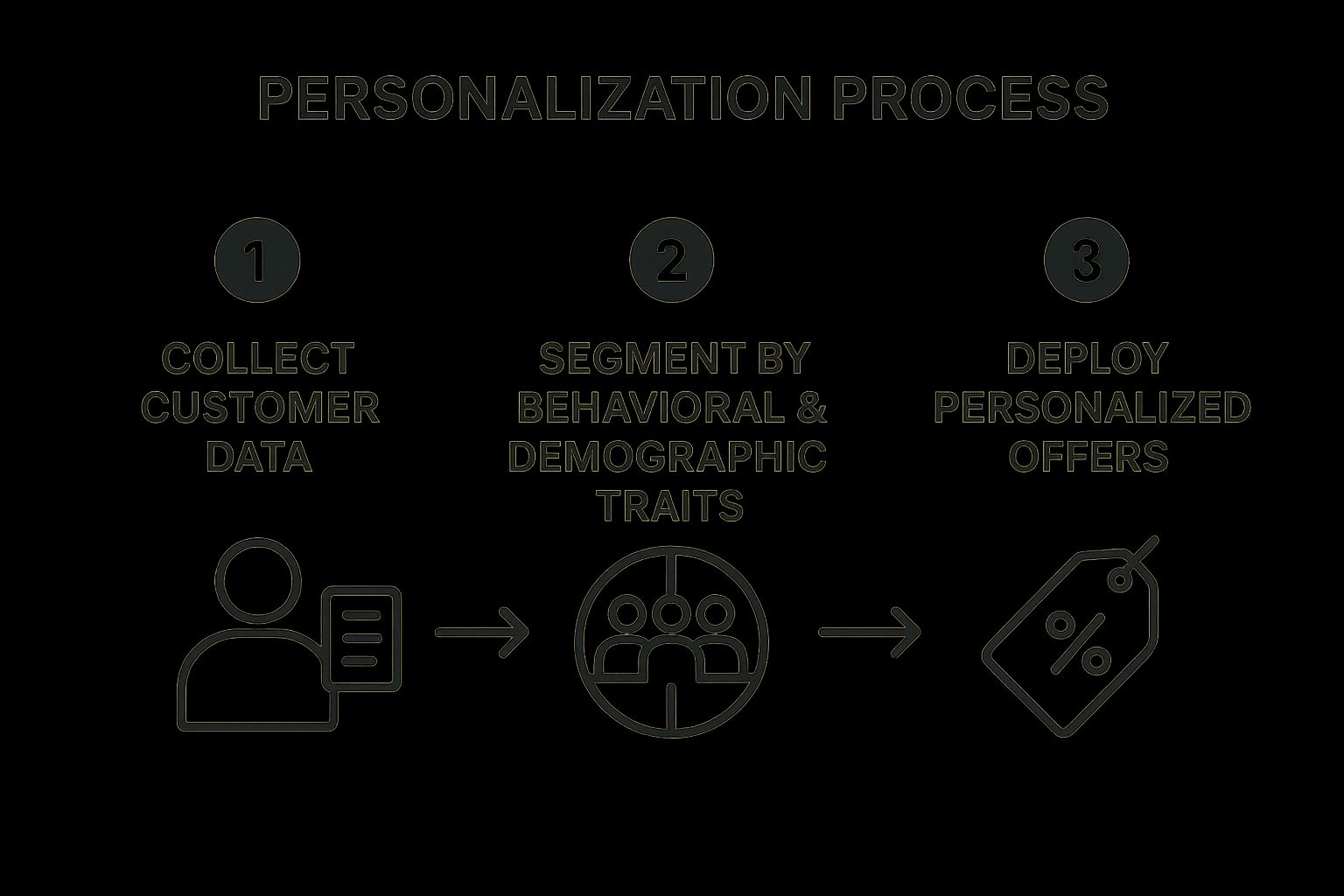
The infographic above visualizes the process of leveraging customer segmentation and personalization to drive business growth. It outlines a cyclical process, starting with data collection and analysis, leading to segmentation and personalized experiences, and ultimately resulting in improved customer engagement and business outcomes.
The process of implementing effective segmentation and personalization, as illustrated in the infographic, is crucial for maximizing its impact on CLTV. The key steps visualized are: Data Collection & Analysis, Customer Segmentation, Personalized Experiences, and Measure & Optimize. The sequential nature emphasizes the importance of starting with a solid understanding of your customer data before attempting to segment and personalize. Continuous measurement and optimization ensure the strategy remains aligned with evolving customer behavior. Without this cyclical approach, efforts can become misaligned and ineffective. The infographic highlights the importance of gathering data to segment customers effectively, then using this segmentation to deliver personalized experiences that drive engagement and revenue.
This strategy deserves its place on any list focused on increasing CLTV due to its proven ability to boost customer engagement, improve conversion rates, and foster loyalty. Features like behavioral, demographic, psychographic, and value-based segmentation allow for highly granular targeting. This translates to personalized product recommendations, targeted marketing communications, custom pricing strategies, and personalized customer service – all powerful tools for driving CLTV growth.
Examples of successful implementation abound:
- Amazon: Personalized product recommendations drive 35% of their revenue.
- Netflix: Their content recommendation engine saves them $1 billion annually through improved customer retention.
- Spotify: Personalized "Discover Weekly" playlists increase user engagement and platform stickiness.
Pros of implementing customer segmentation and personalization:
- Increased Customer Engagement: Relevance drives engagement.
- Improved Conversion Rates: Targeted offers convert better.
- Efficient Marketing Spend: Focus resources on the most receptive segments.
- Stronger Emotional Connections: Personalized experiences build loyalty.
- Better Product Development: Tailor products to segment-specific needs.
Cons to consider:
- Data Management: Requires substantial data collection and management capabilities.
- Implementation Complexity: Can be challenging to set up and manage effectively.
- Privacy Concerns: Responsible data usage is essential.
- Ongoing Maintenance: Segments and strategies require continuous updating.
- Resource Intensive: Can be challenging for smaller companies with limited resources.
Actionable tips for bootstrapped startups and small businesses:
- Start Small: Begin with a few key segments and expand as you gather more data.
- Progressive Profiling: Gradually collect customer data over time.
- Test and Iterate: Experiment with different personalization elements to measure their impact.
- Combine Data Types: Use both explicit preferences and implicit behavioral data.
- Regular Review: Customer behavior evolves, so regularly review and adjust your segmentation.
By focusing on understanding your customers and delivering personalized experiences, you can build stronger relationships, increase engagement, and drive significant improvements in customer lifetime value. This approach, popularized by companies like Amazon, Salesforce, HubSpot, and thought leaders like Seth Godin (author of 'Tribes'), is a proven method for sustainable business growth.
2. Customer Success and Proactive Support
Boosting customer lifetime value (CLTV) is crucial for sustainable business growth, and a powerful strategy to achieve this is through Customer Success and Proactive Support. This approach goes beyond simply reacting to customer issues; it focuses on proactively guiding customers towards achieving their desired outcomes using your product or service. This proactive engagement fosters loyalty, reduces churn, and ultimately increases customer lifetime value.
How it Works:
Customer Success operates on the principle of anticipating customer needs and providing solutions before problems arise. Instead of waiting for support tickets, Customer Success teams actively engage with customers, offering personalized guidance, training, and resources to ensure they're maximizing the value of their purchase. This proactive approach builds a strong partnership between your business and the customer, fostering trust and long-term loyalty.
Features of a Robust Customer Success Program:
- Dedicated Customer Success Managers: Assigning dedicated managers provides personalized attention and builds stronger relationships.
- Regular Check-ins and Review Meetings: Consistent communication keeps customers engaged and allows you to address potential issues proactively.
- Health Scoring: By tracking customer engagement and product usage, you can identify at-risk accounts and intervene before they churn.
- Educational Content and Training Resources: Empowering customers with the knowledge to effectively use your product maximizes their value realization.
- Usage Analytics: Analyzing product usage patterns allows you to identify areas for improvement and tailor your support efforts.
Pros:
- Significantly reduces churn rate: Proactive problem-solving keeps customers satisfied and less likely to leave.
- Creates opportunities for expansion revenue: Happy customers are more likely to upgrade their plans or purchase additional products.
- Builds stronger relationships with customers: Personalized attention and proactive support fosters trust and loyalty.
- Generates valuable product feedback: Direct interaction with customers provides insights for product development and improvement.
- Creates brand advocates and referrals: Satisfied customers become your best marketers.
Cons:
- Can be resource-intensive to scale: Building a dedicated Customer Success team requires investment.
- ROI may take time to materialize: The benefits of Customer Success are often long-term.
- Requires coordination across multiple departments: Successful implementation requires alignment between Sales, Marketing, Product, and Support.
- Difficult to implement for low-value customers: The cost of dedicated support may outweigh the potential CLTV for low-paying customers.
- Requires significant organizational change for traditional companies: Shifting from a reactive to a proactive approach may require significant cultural and operational changes.
Examples of Successful Implementation:
- Salesforce: Their renowned customer success program has contributed to a remarkable 97% renewal rate.
- Slack: Their Customer Success team helps drive their industry-leading net dollar retention of 125%.
- Zoom: Proactive support played a key role in Zoom's explosive growth during the pandemic.
Actionable Tips for Implementing Customer Success:
- Define clear customer success metrics: Align these metrics with customer goals to measure progress effectively. Examples include customer satisfaction scores, product adoption rates, and customer lifetime value.
- Segment customers for appropriate success coverage levels: Not all customers require the same level of support. Segmenting customers allows you to tailor your efforts and allocate resources efficiently.
- Use automation for low-touch success programs at scale: Automation tools can help you deliver personalized content and support to a large customer base.
- Create playbooks for different customer scenarios: Developing standardized processes for common customer issues ensures consistency and efficiency.
- Establish early warning systems for at-risk customers: Proactively identify customers who are showing signs of churn and intervene with targeted support.
Why Customer Success Deserves a Place on this List:
For bootstrapped startups, small business owners, and marketing teams, focusing on customer success is a particularly potent way to increase customer lifetime value. By fostering loyalty and maximizing customer value, you create a sustainable growth engine that requires less investment in acquiring new customers. It's a fundamental shift from transactional interactions to building long-term, mutually beneficial relationships that ultimately drive business success. By investing in Customer Success, you're investing in the long-term health and profitability of your business. This strategy is popularized by thought leaders like Nick Mehta (CEO of Gainsight) and Lincoln Murphy (Customer Success consultant), and exemplified by the success of companies like Salesforce and HubSpot.
3. Value-Based Pricing and Tiered Offerings
Value-based pricing is a crucial strategy for increasing customer lifetime value (CLV). Unlike cost-plus pricing, which focuses on your expenses, value-based pricing aligns your pricing structure with the value customers perceive they are receiving. This allows you to capture more revenue from customers willing to pay a premium for specific features or services, while still catering to price-sensitive segments with more basic offerings. By optimizing monetization across your customer base and creating natural upgrade paths, value-based pricing coupled with tiered offerings significantly boosts CLV.
How it Works:
This strategy involves creating multiple tiers of service or product offerings, each with clearly defined value differentiators. These tiers aren't just about different price points; they represent different levels of value delivered. A basic tier might offer core functionality, while higher tiers progressively unlock additional features, increased usage limits, premium support, or other benefits that resonate with specific customer segments. The pricing for each tier is then directly tied to the perceived value of those features, not solely your costs.
Features of Value-Based Tiered Offerings:
- Multiple Service/Product Tiers: Clear distinctions between tiers with increasing value propositions.
- Pricing Based on Customer-Perceived Value: Focus on what the customer is willing to pay for the benefits received.
- Usage-Based Pricing Components: Align cost with consumption, particularly relevant for software or services.
- Add-on Modules for Customization: Offer additional features that customers can select à la carte to tailor their experience.
- Premium Support or Service Level Agreements: Provide enhanced support options for higher-paying customers.
Examples of Successful Implementation:
- Slack: Slack's freemium model offers a free basic plan, but strategically limits message history and features, creating compelling upgrade triggers for businesses needing more robust communication and collaboration tools.
- Salesforce: Salesforce offers tiered pricing plans designed to capture different business sizes and use cases, ensuring small businesses have an entry point while providing enterprise-level features and support for larger organizations.
- Adobe: Adobe's shift from perpetual licenses to subscription-based tiered offerings has dramatically increased their CLV by providing ongoing value and generating recurring revenue.
Pros:
- Captures more revenue from high-value customers: Extracts maximum value from customers willing to pay for premium features.
- Creates natural upgrade paths for growing customers: As customer needs evolve, they can seamlessly upgrade to a higher tier.
- Allows serving different market segments profitably: Caters to both price-sensitive and premium customers.
- Focuses organization on delivering measurable value: Encourages a customer-centric approach to product development.
- Can increase perceived value through strategic pricing: Positioning higher tiers can make lower tiers appear more attractive.
Cons:
- Requires deep understanding of customer value perception: Market research is crucial for accurate pricing.
- May complicate sales process if poorly implemented: Overly complex tiers can confuse customers.
- Can create customer segmentation challenges: Identifying the right value metrics for each segment is critical.
- Requires regular review and adjustment: Pricing tiers should be dynamic and adapt to market changes.
- May introduce feature bloat to justify premium tiers: Avoid adding unnecessary features just to differentiate tiers.
Tips for Implementing Value-Based Tiered Pricing:
- Focus pricing tiers on value metrics customers care about: Conduct thorough customer research to identify these metrics.
- Make upgrade paths obvious and frictionless: Simplify the upgrade process to encourage customers to move up tiers.
- Use customer research to identify willingness to pay: Don't underestimate what customers are willing to pay for real value.
- Test different pricing structures with small segments: A/B testing helps optimize pricing for maximum conversion and CLV.
- Review pricing strategy at least annually: Market dynamics change, and your pricing should adapt accordingly.
Why Value-Based Pricing Deserves Its Place:
Value-based pricing with tiered offerings is essential for maximizing CLV because it allows you to extract the full potential from your customer base. By understanding and catering to different customer needs and willingness to pay, you create a system that encourages growth, loyalty, and ultimately, increased revenue. This approach is especially beneficial for bootstrapped tech startups, small business owners, and sales & marketing teams looking to optimize their revenue streams and build sustainable growth. This strategy, popularized by experts like Patrick Campbell (ProfitWell/Paddle) and Tom Tunguz (Redpoint Ventures), has proven highly effective for companies like Adobe and Zoom, making it a vital consideration for any business seeking to increase customer lifetime value.
4. Subscription and Membership Programs
Subscription and membership programs are a powerful engine for increasing customer lifetime value (CLTV). They transform one-time buyers into recurring revenue streams by offering ongoing value through exclusive access, convenience, or cost savings. This model fosters predictable revenue and deepens customer relationships through regular engagement. By securing customer commitment for extended periods and increasing switching costs, businesses dramatically increase CLTV while gaining better visibility into future revenue.

This approach deserves a prominent place on any list focused on increasing CLTV due to its proven ability to generate consistent revenue and foster long-term customer loyalty. Key features of successful subscription and membership programs include recurring billing (monthly or annually), tiered membership levels with escalating benefits, exclusive content or subscriber-only features, auto-replenishment of consumable products, and member community/networking opportunities. Think of the tiered approach used by software companies – offering basic, premium, and enterprise levels – or the community aspect of a gym membership.
Examples of Successful Implementation:
- Amazon Prime: Prime members, driven by the annual subscription, spend 2.3x more than non-members, demonstrating the power of exclusive benefits and convenience.
- Apple: Apple's strategic shift towards subscription services for music, storage, and software has significantly boosted their customer lifetime value.
- Dollar Shave Club: This company disrupted the razor industry with its subscription model, ultimately being acquired for $1 billion, highlighting the potential for even simple products within this model.
Pros:
- Predictable, Recurring Revenue: This allows for better financial forecasting and planning.
- Increased Customer Switching Costs and Loyalty: Subscribers are less likely to switch to competitors.
- Data for Forecasting and Planning: Subscription data provides valuable insights into customer behavior.
- Deeper Customer Relationships: Regular engagement fosters stronger connections.
- Increased Total Customer Spending: Subscribers often spend more overall than one-time buyers.
Cons:
- Continuous Delivery of Compelling Value: Maintaining subscriber interest requires ongoing effort.
- Potential Increase in Customer Acquisition Costs: Attracting subscribers can be more expensive.
- Churn Management Becomes Critical: Minimizing subscriber loss is essential for success.
- Potential Cannibalization of Higher-Margin One-Time Purchases: A subscription might replace a more profitable one-time sale.
- Growing Expectations for Member Benefits: Subscribers tend to expect more value over time.
Actionable Tips for Implementation:
- Focus on Value that Improves with Continued Usage: The more a customer uses your service, the more valuable it should become.
- Make Cancellation Fair But Not Too Easy: A simple process, but not frictionless, reduces churn.
- Regularly Introduce New Benefits to Combat Subscription Fatigue: Keep the offering fresh and exciting.
- Consider Annual Billing with a Discount to Improve Retention: This incentivizes longer-term commitment.
- Measure and Optimize for Retention Cohorts: Track the performance of different subscriber groups.
When and Why to Use This Approach:
Subscription and membership programs are particularly well-suited for businesses offering products or services that are consumed regularly or require ongoing engagement. This includes software, digital content, consumable goods, and services with recurring needs. For bootstrapped tech startups and small businesses, this model offers a predictable revenue stream that can be crucial for growth and stability. Sales and marketing teams can leverage subscriptions to build stronger customer relationships and increase overall revenue. Operations managers benefit from the predictability of recurring revenue for better resource allocation and planning. By focusing on delivering consistent value and managing churn effectively, businesses can leverage subscription and membership programs to significantly increase customer lifetime value.
5. Strategic Cross-Selling and Upselling: Unlock Hidden Revenue Within Your Existing Customer Base
Strategic cross-selling and upselling are powerful techniques to increase customer lifetime value (CLTV) by maximizing the revenue generated from each customer. Instead of constantly chasing new acquisitions, these strategies focus on deepening relationships with your existing customer base, offering them additional value, and ultimately, increasing their spending. This approach is particularly valuable for bootstrapped tech startups, small business owners, and sales/marketing teams looking to maximize ROI on customer acquisition costs.
How it Works:
Cross-selling involves offering complementary products or services to an existing customer. Think of a customer buying a laptop, and then being offered a laptop bag, mouse, or extended warranty. Upselling, on the other hand, focuses on persuading a customer to purchase a higher-end or premium version of the product they're already interested in. For example, suggesting a customer upgrade to a laptop with more storage or a faster processor.
The key to effective cross-selling and upselling lies in understanding your customer's needs and behavior. Data-driven product recommendations are crucial. Instead of generic offers, you want to present targeted suggestions that genuinely enhance the customer's experience.
Features of Effective Cross-Selling and Upselling:
- Data-driven product recommendations: Analyze purchase history, browsing behavior, and demographics to suggest relevant products.
- Bundled solutions addressing related needs: Package complementary products together at a discounted price to incentivize purchase.
- Upgrade paths with clear value differentiation: Clearly communicate the benefits of upgrading to a premium product or service.
- Contextual offers triggered by usage patterns: Offer relevant upsells or cross-sells based on how a customer uses your product.
- Customer success-driven expansion opportunities: Proactively suggest additional products/services that can further help customers achieve their goals.
Pros:
- Increases average order value and customer lifetime value: Customers spend more per transaction and over their relationship with your business.
- Enhances customer experience with complementary solutions: Provides added value and improves overall satisfaction.
- Leverages existing customer relationships (lower acquisition cost): Selling to existing customers is significantly cheaper than acquiring new ones.
- Creates opportunities for deeper solution penetration: Strengthens customer loyalty and dependence on your product ecosystem.
- Often improves overall product adoption and satisfaction: Helps customers get the most out of your offerings.
Cons:
- Can feel pushy if poorly implemented: Aggressive or irrelevant offers can damage customer relationships.
- May distract from core product experience: Too many upsells can overwhelm customers and detract from the main offering.
- Requires sophisticated customer data analysis: Effective implementation necessitates robust data collection and analysis capabilities.
- Can increase support complexity with multiple products: Offering more products can lead to increased support inquiries.
- May temporarily strain delivery/onboarding resources: Increased sales might require adjustments to delivery and onboarding processes.
Examples of Successful Implementation:
- Amazon: Their recommendation engine, which drives 35% of their revenue, is a prime example of data-driven cross-selling.
- Apple: Their ecosystem of interconnected products (iPhone, iPad, Apple Watch, etc.) increases switching costs and CLTV through seamless cross-selling.
- Hubspot: Grew from a single product to an integrated marketing platform through strategic product expansion and upselling.
Actionable Tips for Implementation:
- Focus on recommendations that solve adjacent problems: Don't just push products; offer solutions that complement existing purchases and address related needs.
- Time upsell offers based on usage milestones and success: Offer upgrades when customers are experiencing value from your core product.
- Train customer-facing teams on consultative cross-selling: Equip your team to identify and address customer needs effectively.
- Test and measure different recommendation approaches: Experiment with various cross-selling and upselling strategies to optimize results.
- Use customer data to identify logical next purchases: Analyze purchase patterns and customer segments to predict future needs.
Why This Deserves a Place on the List:
Increasing customer lifetime value is a critical goal for any business. Strategic cross-selling and upselling provide a highly effective and efficient way to achieve this, leveraging existing customer relationships to generate more revenue, improve customer satisfaction, and build a more sustainable business model. For bootstrapped startups and small businesses, this is often a more accessible and cost-effective growth strategy than focusing solely on new customer acquisition.
6. Loyalty and Rewards Programs
Loyalty and rewards programs are a powerful strategy to increase customer lifetime value (CLTV) by incentivizing repeat purchases and fostering long-term relationships. These programs operate on the principle of rewarding customers for their continued patronage, thereby modifying their behavior to increase purchase frequency, volume, and overall engagement with your brand. Modern loyalty programs go beyond simple discounts, focusing on building emotional connections, offering exclusive perks, and creating a sense of community belonging that drives enduring loyalty and positive word-of-mouth marketing. This approach shifts the customer's focus from transactional value to relationship value, making them less price-sensitive and more invested in your brand.

A well-structured loyalty program offers a range of features designed to engage customers at different levels. These can include traditional points accumulation and redemption systems, tiered status levels with escalating benefits (e.g., free shipping, priority customer service), experiential rewards (e.g., exclusive events, early access to new products), and gamification elements to enhance engagement and encourage specific actions. Providing exclusive access to products, events, or content further strengthens the customer’s connection with the brand.
Why Loyalty Programs Deserve a Place in Your CLTV Strategy: Loyalty programs directly impact several key drivers of CLTV. Increased purchase frequency and larger basket sizes are natural outcomes of a compelling rewards system. Programs also create switching costs for customers, making it less attractive to move to a competitor. Furthermore, these programs are invaluable for collecting first-party customer data, enabling personalized marketing efforts and a deeper understanding of customer behavior. Perhaps most importantly, a well-designed program fosters an emotional connection beyond transactions, turning customers into brand advocates.
Pros:
- Increases purchase frequency and average order value.
- Creates switching costs and reduces customer churn.
- Generates valuable first-party customer data for personalized marketing.
- Builds emotional connection and brand advocacy.
- Provides a platform for targeted communications and promotions.
Cons:
- Can be costly to implement and maintain if not structured effectively.
- Reward liability needs careful management to ensure profitability.
- May attract primarily discount-focused customers.
- Requires continuous evolution and innovation to maintain customer interest.
- Can be difficult to differentiate from competitors' programs.
Examples of Successful Implementation:
- Starbucks Rewards: Members account for over 50% of spend in company-owned stores, demonstrating the power of a well-executed loyalty program.
- Amazon Prime: Evolved from a free shipping program into a comprehensive loyalty ecosystem encompassing streaming services, exclusive deals, and more.
- Sephora's Beauty Insider: This tiered program fosters a strong sense of community through exclusive content, events, and personalized recommendations.
Actionable Tips for Building a Successful Loyalty Program:
- Align with your brand values: Rewards should resonate with your target audience and reinforce your brand identity.
- Prioritize emotional and status benefits: Go beyond discounts and offer exclusive experiences and recognition.
- Create clear paths to higher tiers: Motivate customers by providing achievable goals and visible progress markers.
- Leverage data for personalization: Use program data to tailor rewards and communications to individual customer preferences.
- Refresh program benefits regularly: Combat program fatigue by introducing new rewards and challenges to keep customers engaged.
For bootstrapped tech startups and small business owners, even a simple points-based system can be a valuable starting point. As your business grows, consider incorporating tiered structures, experiential rewards, and gamification to further enhance engagement and increase customer lifetime value. For sales and marketing teams, loyalty programs provide a powerful tool for customer segmentation, targeted promotions, and building long-term customer relationships. Digital marketing professionals can leverage program data to optimize online campaigns and personalize the customer journey. Finally, operations managers play a crucial role in ensuring the smooth execution and management of the program's logistics. By carefully considering these factors and implementing a strategic loyalty program, businesses of all sizes can effectively increase customer lifetime value and foster sustainable growth.
7. Customer Education and Enablement: Turn Users into Power Users and Advocates
Customer education and enablement is a powerful strategy to increase customer lifetime value (CLTV) by systematically increasing customer mastery of your product or service. This approach focuses on empowering customers to achieve greater utilization, realize the full value of your offering, and ultimately, remain loyal customers for longer. By investing in customer knowledge and capability building, you’re not just selling a product; you're fostering success, transforming support costs into retention investments, and building deeper customer relationships based on mutual benefit. This is why it deserves a prominent place in any CLTV enhancement strategy.
How it Works:
Customer education and enablement initiatives provide customers with the resources and support they need to effectively use your product or service. This involves creating a learning ecosystem that caters to different learning styles and customer journey stages. As customers gain proficiency, they experience greater value, leading to increased satisfaction, reduced churn, and increased opportunities for upselling and cross-selling. Empowered customers also become advocates, driving organic growth through referrals and positive word-of-mouth.
Features of Effective Customer Education Programs:
- Structured Onboarding Programs: Guide new users through initial setup and key features, ensuring a smooth and positive first experience.
- Self-Service Knowledge Bases and Learning Centers: Empower customers to find answers and solutions independently through FAQs, tutorials, and documentation.
- Certification Programs for Advanced Users: Recognize and reward customer expertise, fostering deeper engagement and brand loyalty.
- Webinars and Live Training Sessions: Offer interactive learning experiences that cater to specific needs and skill levels.
- User Communities for Peer Learning: Facilitate knowledge sharing and mutual support among customers, creating a sense of belonging and shared success.
Pros:
- Dramatically reduces churn: By improving product adoption and satisfaction.
- Decreases support costs: Through self-service resources and empowered users.
- Creates opportunities for upsell: When users master basic functionalities and seek advanced features.
- Builds deeper psychological investment: Customers become more invested in your solution as their skills and knowledge grow.
- Creates brand advocates and product experts: Satisfied power users become valuable promoters of your brand.
Cons:
- Requires significant content development investment: Creating high-quality educational materials takes time and resources.
- ROI can be difficult to measure directly: Although the impact on CLTV is significant, it can be challenging to isolate and quantify.
- Needs continuous updating as product evolves: Educational content needs to stay current with product updates and new features.
- May cannibalize professional services revenue: If customers can achieve desired outcomes through self-education, they might be less inclined to purchase professional services.
- Customers may not allocate time for education: Busy schedules can make it difficult for customers to prioritize learning new tools.
Examples of Successful Implementation:
- HubSpot Academy: Offers free certification programs that equip marketers with valuable skills and deepen their engagement with HubSpot’s platform.
- Salesforce Trailhead: Provides a gamified learning platform that makes learning about Salesforce products engaging and rewarding.
- Adobe: Extensive learning resources helped Adobe reduce churn during their transition to a subscription model.
- Apple (Today at Apple): Offers free workshops and sessions that empower users to get the most out of their Apple products.
Actionable Tips for Implementation:
- Map education content to customer journey stages: Tailor educational materials to the specific needs and challenges customers face at each stage.
- Use multiple learning formats for different preferences: Cater to diverse learning styles by offering videos, written guides, interactive tutorials, and live sessions.
- Embed education within the product experience: Provide contextual help and guidance within the product itself.
- Celebrate customer achievement and mastery: Recognize and reward customers who complete training programs or achieve specific milestones.
- Connect education directly to customer outcomes: Emphasize how learning will help customers achieve their desired results.
When and Why to Use This Approach:
Customer education and enablement is particularly valuable for businesses offering complex products or services with a steep learning curve. It's an ideal strategy for SaaS companies, technology providers, and businesses looking to build long-term customer relationships based on shared success. By prioritizing customer education, businesses can effectively increase customer lifetime value, reduce churn, and foster a community of loyal brand advocates.
7 Strategies to Boost Customer Lifetime Value
| Strategy | Implementation Complexity 🔄 | Resource Requirements ⚡ | Expected Outcomes 📊 | Ideal Use Cases 💡 | Key Advantages ⭐ |
|---|---|---|---|---|---|
| Customer Segmentation and Personalization | High 🔄🔄 | High ⚡⚡ | Higher engagement, improved conversion, increased CLV 📊📊 | Businesses with rich customer data and marketing focus | Tailored experiences, efficient marketing spend, stronger customer bonds ⭐⭐ |
| Customer Success and Proactive Support | Medium-High 🔄🔄 | High ⚡⚡ | Reduced churn, expansion revenue, stronger relationships 📊 | SaaS, subscription, and high-touch B2B businesses | Proactive retention, improved loyalty, actionable feedback ⭐⭐ |
| Value-Based Pricing and Tiered Offerings | Medium 🔄 | Medium ⚡ | Increased revenue, natural upgrades, better monetization 📊 | Companies with diverse customer value perceptions | Revenue optimization, clear upgrade paths, market segmentation ⭐⭐ |
| Subscription and Membership Programs | Medium 🔄 | Medium ⚡ | Predictable revenue, increased loyalty, higher customer spend 📊 | Recurring revenue models, consumer & B2B | Stable income, stronger retention, data-driven forecasting ⭐⭐ |
| Strategic Cross-Selling and Upselling | Medium 🔄 | Medium ⚡ | Increased average order value and CLV, better adoption 📊 | Businesses with diverse product portfolios | Enhanced customer value, leverages existing base, drives product adoption ⭐ |
| Loyalty and Rewards Programs | Medium 🔄 | Medium ⚡ | Increased purchase frequency and retention, emotional connection 📊 | Retail, consumer brands, and service-based businesses | Emotional bonds, switching cost creation, valuable data capture ⭐ |
| Customer Education and Enablement | Medium-High 🔄 | High ⚡⚡ | Reduced churn, higher product adoption, more advocacy 📊 | Complex products/services needing user mastery | Lower support costs, deeper engagement, upsell opportunities ⭐ |
Turning Strategies into CLV Growth
Increasing customer lifetime value (CLV) is not a one-time fix, but rather an ongoing commitment to nurturing customer relationships and providing exceptional value. We've explored several key strategies, from customer segmentation and personalized experiences to loyalty programs and strategic upselling/cross-selling. Implementing even a few of these tactics can significantly impact your bottom line. Remember, customer success and proactive support are cornerstones of CLV growth. Value-based pricing, tiered offerings, and subscription models can create recurring revenue streams while strengthening customer loyalty. For businesses dealing with physical spaces and client interactions, robust property management strategies can also play a vital role in enhancing the customer experience and boosting CLTV. This resource from Showdigs offers valuable insights into effectively managing various aspects of the customer lifecycle within these specific contexts.
The most important takeaway is this: focusing on increasing customer lifetime value shifts your perspective from transactional exchanges to building lasting relationships. Mastering these approaches translates directly to increased profitability, sustainable growth, and a thriving community of brand advocates. It allows you to not only acquire customers but retain them, transforming them into loyal champions of your brand.
Start by identifying the strategies that best align with your business model and customer base. Then, implement them methodically, measuring results and refining your approach over time. Small changes can yield significant results, and the journey towards maximizing CLV is a marathon, not a sprint.
Ready to streamline your processes and unlock the full potential of your customer relationships to increase customer lifetime value? Bodhi Creative Collective specializes in helping businesses refine and automate processes for optimal CLV growth. Visit Bodhi Creative Collective today to learn how we can help you build a thriving, loyal customer base.
